haBItat at one oF the legacy
lIFestyle propertIes.
two-hour drive from Johannesburg and ten
minutes from Sun City, lies a place of breath-
taking beauty and serenity. Bakubung, or
"People of the Hippo", offers you everything
you need to get in touch with the bush.
bakubung.co.za
from the sumptuous comfort of Gorah, an
exclusive game lodge located in the heart of
the Addo Elephant National Park. Restored
to its 19th century Colonial splendour the
Gorah House has been declared a National
Monument.
and the Zuurberg Mountains, Kuzuko Lodge
lies in a private concession to the north of
the Addo Elephant National Park, the third
largest national park in South Africa in a
malaria-free region.
Bush Lodge, where Mother Nature and
guests meet in perfect harmony. Located
on the slopes of an ancient volcano, Kwa
Maritane offers guests all the amenities
of a prime resort a mere two hours from
Johannesburg.
African landscape, embraces the spirit and
glory of ancient Africa. Framed by towering
mountains overlooking vast plains teeming
with game, merging into undulating bushveld
with winding rivers cutting through dramatic
gorges.
against the side of a hill surrounded by the
mountains of the Pilanesburg National Park;
lies Tshukudu, one of Africa's most romantic
bush lodges. Each custom designed lodge
offers a romantic sunken bath, an open plan
lounge and bedroom, with a fireplace and
private balcony.
For memBers
Visit legacylifestyle.co.za
Phylum: Chordata
Class: Mammalia
Order: Carnivora
Family: Felidae
Genus: Caracal
Species: C. caracal
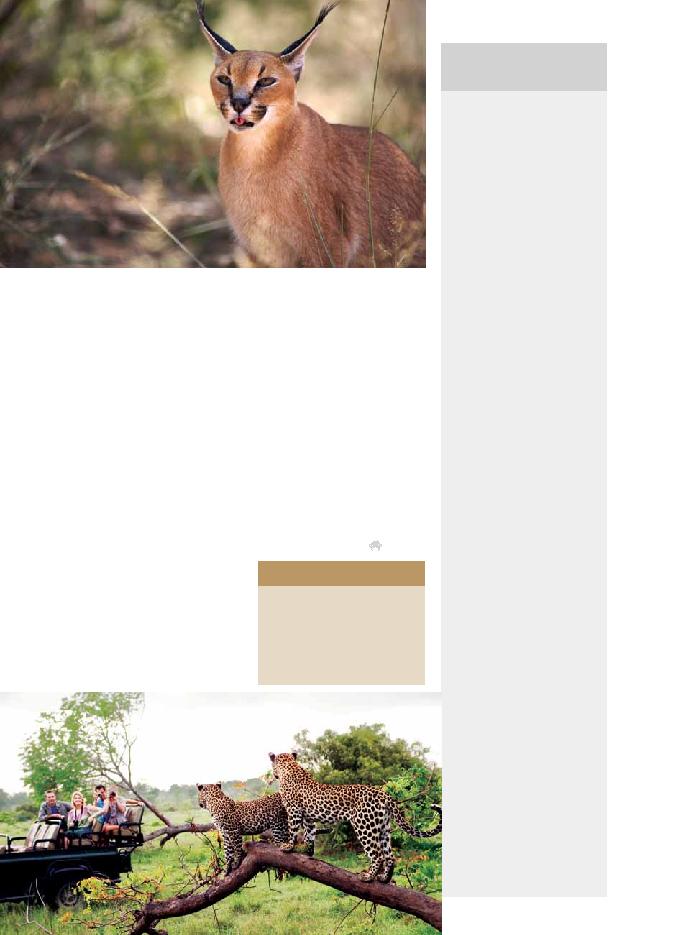
a Turkish work "karakulak" which means black
ear, fitting for this small cat's black tufts of
hair that can be distinctively found at the tip
of each ear. While in Pakistan it is also known
as "black ears" or syahgosh it is best known
in South Africa by the Afrikaans name Rooikat
or red cat.
a pest for picking off livestock is no longer
classified as a lynx and is now believed to be
more closely related to the African golden cat
and the serval.
far the heaviest, although it is slender it is also
muscular with long legs and a short tail. Males
are significantly larger than females and can
weigh between 13 19kgs while the females
clock in at a meagre 6 12kgs in comparison.
There are no other distinctive features to
differentiate males from females.
between a wine-red grey or a sandy brown.
The only markings on an adult caracal are
small black spots above the eyes and small
white patches around the eyes and the nose.
Their undersides are largely white and a
narrow black line runs from the corner of the
eye to the nose.
of most cats and its most notable feature is its
long tufted black ears from which it takes its
name. The caracal is found throughout Africa,
the Middle East, Pakistan and India and it
prefers dry steppes, semi-deserts, savannah
and scrub areas. This little cat is remarkably
resilient and can survive for long periods
without water, taking sustenance from its prey,
it is also exceptionally easy to tame.
more territorial than her male counterpart and
will actively defend her territory from other
cats. One of its most spectacular skills is
being able to catch a bird in flight, it can also
jump and climb exceptionally well making it an
excellent hunter.
because of its propensity to prey on livestock
leading to many farmers killing them when
caught or seen around the farm.