you immerse yourself in bustling city-life, soak
up the cosmopolitan culture of your host country,
shop for bargains and mementoes and enjoy a
busy schedule of entertainment and nightlife,
look no further than Brazil. And if you can
choose only one city to visit in Brazil, make that
city Rio de Janeiro.
Despite the exotic images the name `Rio de
Janeiro' evokes, the name itself translates merely
as `January River'.
exquisite beauty of Rio and fewer still that boast
as many world-famous landmarks as it does.
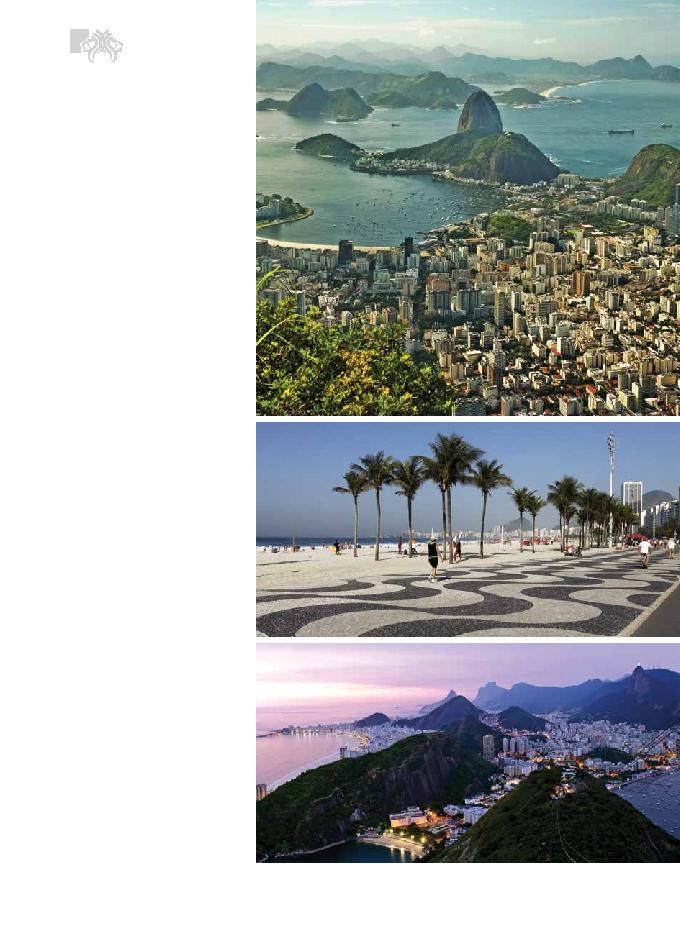
The monumental 39.6m tall and 30m wide statue
of Christ the Redeemer on its 9.5m pedestal,
atop the 700m peak of Corcovado mountain is
perhaps the most famous of these and one that
is listed as one of the New Seven Wonders of the
World. Sugarloaf Mountain, the monolithic hill of
granite and quartz at the mouth of Guanabara
Bay, is another.
Site status. The UNESCO inscription for Rio de
Janeiro reads:
encompasses the key natural elements that have
shaped and inspired the development of the city:
from the highest points of the Tijuca National
Park's mountains down to the sea. They also
include the Botanical Gardens, established in
1808, Corcovado Mountain with its celebrated
statue of Christ and the hills around Guanabara
Bay, including the extensive designed landscapes
along Copacabana Bay which have contributed
to the outdoor living culture of this spectacular
city. Rio de Janeiro is also recognised for the
artistic inspiration it has provided to musicians,
landscapers and urbanists."
Ipanema, Leblon and Barra da Tijuca beaches.
hostels, restaurants, bars and nightclubs. The
glorious white sands of the four-kilometre long
beach are framed by the distinctive wave-
patterned Copacabana promenade, whose
black and white tiles have withstood more
than 40 years of frenzied traffic to become a
landmark. For the military history enthusiast, the
beach boasts historic forts at both ends Fort
Copacabana on the south side, built in 1914, and
Fort Duque de Caxias, built in 1779, on the north.
and before that, its Maracanã Stadium will host
the final match of the 2014 FIFA World Cup.