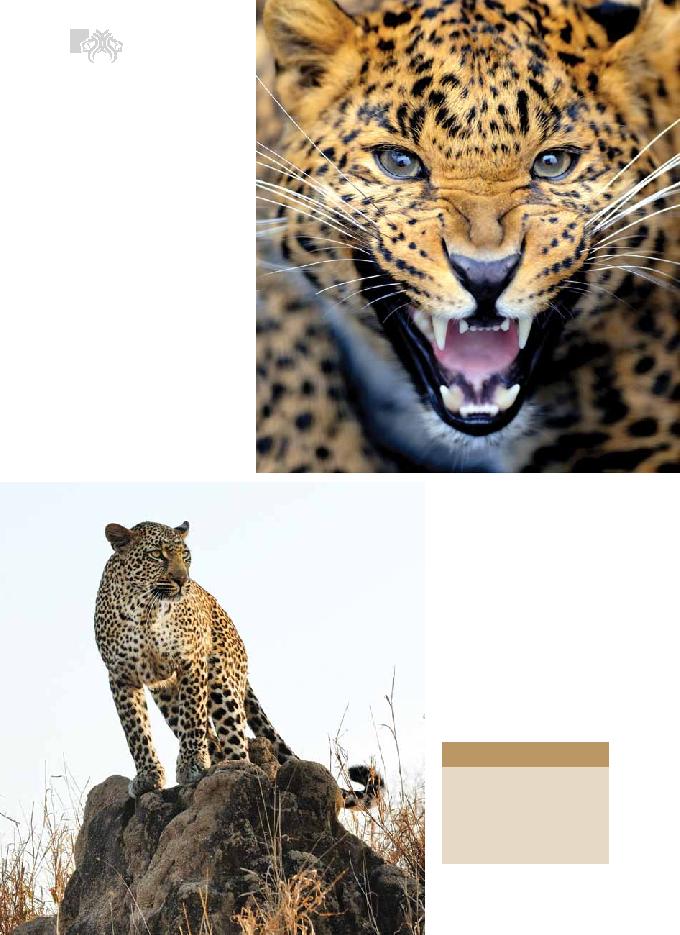
the leopard is one of the smallest, although
is still bigger than the caracal. The leopard
was once widely found across much of Africa
and Asia yet today its habitat is now limited to
sub-Saharan Africa with small concentrations
and minute populations still found in parts of
Asia. With its rapidly dwindling numbers and
loss of habitat the leopard is considered a "near
threatened" species.
with a rather large head. While it looks similar
to a jaguar it is smaller and more slightly built,
its fur is also marked with rosettes similar to
the jaguar but they are more tightly packed
and smaller in nature.
whichever habitat it finds itself in. Able to run
at speeds up to 58km/h it is no slouch in the
athletics department either. It is also able to
can climb trees all the while carrying a heavy
carcass. The leopard prefers to keep its meals
in a tree away from other scavengers and it is
known for its stealth, being able to sneak up
on prey without being detected. It isn't fussy
either and its opportunistic nature means it will
eat whatever it can kill.
usually draped on tree limbs or lying in thick
undergrowth. As a result they're difficult to
see, unless you're lucky enough to spot one
resting or sunning itself on a rock or tree limb.
Once darkness sets in, they move around
intermittently until after dawn.
Occupation of a territory is advertised by
marking with urine and faeces and clawing the
bark of trees.
Phylum: Chordata
Class: Mammalia
Order: Carnivora
Family: Felidae
Genus: Panthera
Species: P. pardus