Olympic Games are exciting events on the city's
calendar, Rio is by no means a newcomer to the
staging and hosting of large-scale events.
Lent, they fuel up on the pleasures of the flesh
during five days of unrestrained, unreserved
and unrepentant partying. Some watch from the
sidelines as others perform, but in truth there are
no spectators, all are participants in the biggest
party on earth the Carnival in Rio de Janeiro.
street parties of the Rio Carnival are the stuff of
legend. Carnival is not however unique to Rio.
The annual event is celebrated in towns and
villages throughout Brazil and in many other
Catholic countries too, though none rival the
spectacle that is the Rio Carnival.
keys of the city to King Momo, the Lord of
until Ash Wednesday. The period that follows
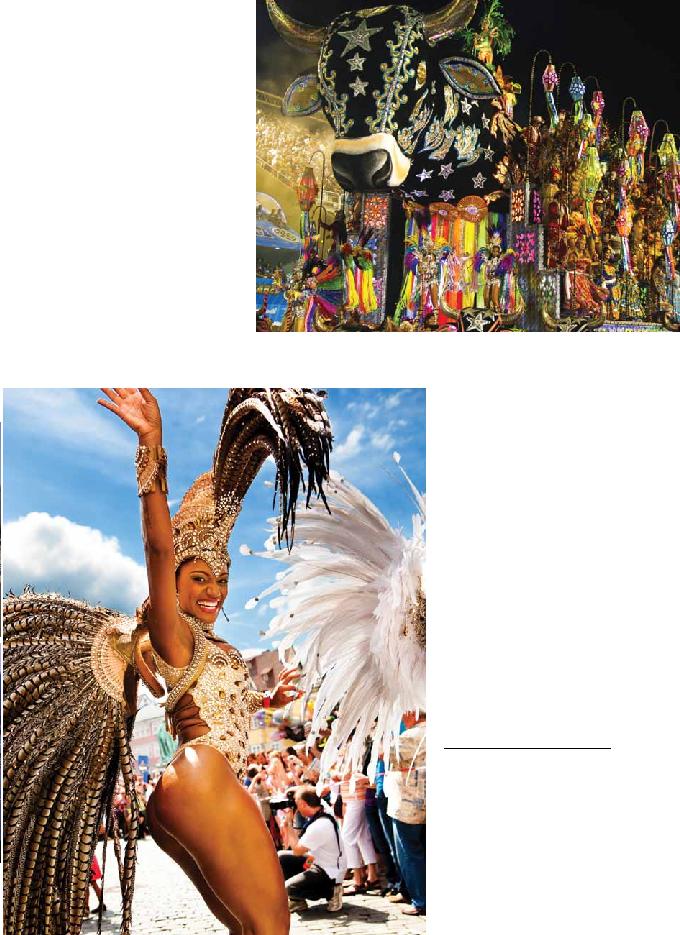
can be described as an almighty street party
in which some two million people take to the
bloco street parades, others to view the grand
parade that marks a showdown between the
city's Samba Schools and takes place in the
city's enormous Sambadrome and still others to
hobnob with high society at the grand balls at
the Copacabana Palace and beach.
Catholicism and yet we must. Nowadays,
the modern carnival represents the final act
of indulgence before the abstinence of Lent.
Historically, however, Carnival can be traced
back to an ancient Greek spring festival, held
in honour of Dionysus, the God of wine. The
practice was later adopted by the Romans and
absorbed into their Bacchanalia and Saturnalia
festivals. Whatever the ostensible reasons for
these festivals, all were in essence drunken
orgies of unfettered revelry and while the
Catholic Church did its best to adopt, modify
and give the practice a Christian context, in view
of the madness of Carnival, the success of its
efforts is questionable.
of the city's annual beer consumption and 70%
of its annual tourist income. Anywhere between
500,000 and 850,000 tourists visit the city each
year to participate in Carnival and combined
with the locals the revellers number around two
million per day. In 2013, Rio Carnival will start on
8 February and end on 12 February.