50
GA
/ Vol. 5 / No. 3 / MARCH 2013
The first successful unmanned aircraft
in service was arguably the V1 flying
bomb, developed by the team of
Werner Von Braun at Peenemünde
during the second world war. Its
objective was arguably a bit dubious
trying, without a great deal of success,
to destroy London. However, it was
nonetheless a marvellous piece of
engineering. Flown from a simple
launch ramp in 1944 or 1945, it flew
itself using a single axis autopilot some
140 nautical miles, at an impressive
350 knots, carrying just under a
tonne of payload and quite a few
of them even hit their targets. Within
another 3 years that technology had
been adapted enough to cross the
Atlantic a Douglas C54 Skymaster
flew under automatic control, albeit
with a crew on board to push the
occasional button in between card
games, from Newfoundland to RAF
Brize Norton in England in 1947.
And in 65 years since, all sorts
of things have been done with the
technology of unmanned aircraft
complex autopilots in massive
airliners, tiny unmanned machines
taking video for police and news
services, cruise missiles, autonomous
helicopters resupplying troops in
Afghanistan, and many technologies
by Dr Guy Gratton
Aircraft Technical
in between . Not to mention, the
adaptation of that technology to
tasks as mundane as domestic
central heating, and as incredible as
sending a probe to land on Mars.
So given all that incredible
technology is out there, just why
exactly are we not surrounded by what
we've come to call Unmanned Air
Vehicles, or UAVs. They are frankly
still just filling tiny niche applications
which seem a far cry from what the
technology should be capable of.
What's the basic problem that prevents
pilots the worldwide being laid off,
cockpits emptied, millions in expense
accounts saved, and the airline unions
rendered irrelevant? It's often argued
that the reason is that passengers
wouldn't be happy flying without a
pilot up the front to talk to them but
this is clearly untrue as train passengers
regularly travel around the world on
unmanned trains including the inter-
terminal monorails at lots of major
airports. So, it's not hard to believe that
airline passengers could be persuaded
also to fly in unmanned aeroplanes.
No, the people who need
convincing are actually the world's
aviation authorities who remain
completely unconvinced that
unmanned aircraft are a good idea.
The basic reasons are twofold
firstly the unmanned aircraft
lacks a pair of eyes, and secondly
that it lacks a human brain.
Think about this absolutely
possible situation. An airliner is
outbound from the nearest regional
airport to your home. It is just leaving
controlled airspace for a few tens of
miles cruise-climb in VMC conditions
through uncontrolled airspace up
into an airway before it activates
its IFR flightplan and heads a few
thousand miles onwards through the
airway system to its destination. The
pilot handling, maintaining a good
lookout and having the required
excellent vision, resolves a white
painted homebuilt aeroplane from a
layer of scattered cloud in front of
him, not moving in his field of view.
Realising the risk of collision, he turns
the aeroplane off his planned track
avoiding the collision, explaining
the issue to his crew and ATC, and
then carrying on with little incident.
Here's another situation I know
this is possible as it happened to
me a light aircraft with a pilot and
passenger is taking off from a local
airport when at a few hundred feet the
engine starts rough running. Having
no landable fields in front he turns back
to force a landing on the downwind
runway, which then proves impossible
because of the strong headwind he
took off into. Manoeuvring over the
surrounding town and milking the wind
for everything he can, he manages to
put the aircraft down on an unmarked
and disused crosswind runway, saving
the aircraft and the passenger.
These two incidents have
something in common: a human
head in the front of the aeroplane.
Technology exists to detect transponder
returns, to detect particular types
of storm clouds, and even to detect
icing, or pick up strobes. The human
eyeball remains however by far the
best device that we have for picking
up a non-squawking white fibreglass
aeroplane flying non-radio against
a background of white cloud. Or a
parachutist, or a flock of birds, or a
runaway hot air balloon with nobody in
it. (If you happen to be a fan of 1970s
rock, you might know the famous
Pink Floyd "Animals" album cover
of a giant inflatable pink pig floating
in front of London's Battersea power
station. It's less well known that that
flying pig got away during the photo
shoot and several airliners heading into
London Heathrow had to take avoiding
action.) Similarly the combination of
human brain and human eye is very
capable of judging when and where
to force-land an aeroplane, judging
the condition of crops, height of
trees or whether a disused runway,
or the Hudson River, might allow a
survivable landing. At the moment, the
technology really doesn't exist to make
these sort of judgements half as well.
In aerospace engineering, this
immature technology is known as
"Sense and Avoid". But, it needs
to include a lot of decision making
in there as well, which means a lot
of expensive computing power,
not to mention the ability to learn,
and resolve faint patterns.
All of this will I've no doubt be
solved: here in Britain a BAeS led
consortium called ASTRAEA has
been flying a modified Jetstream for
some years now trying to continuously
develop improved sense and avoid
logic. They've been flying it around
in crowded mixed airspace (albeit
with a couple of human test pilots up
the front, just in case) they're not
there yet, but they're getting closer.
Universities and other research teams
worldwide have been working hard
The unmanned problem
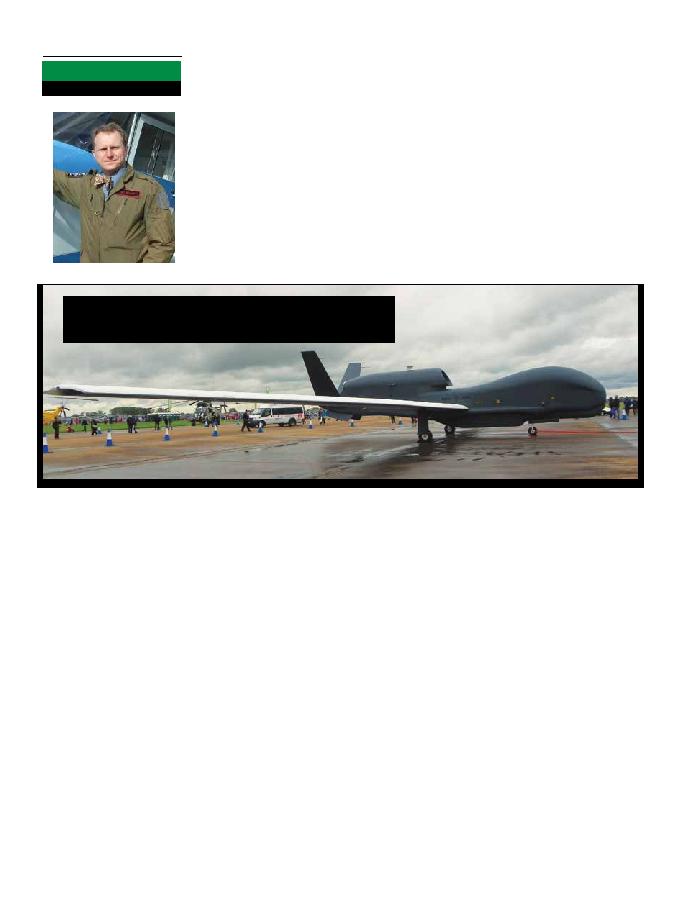
"Global Hawk: the world's biggest UAV, but still banned from flying in airspace alongside manned aircraft.
at the technology of "seeing" patterns
and detecting anomalies for a whole
range of reasons, but especially
this one. The robustness of control
technology is being improved yearly,
with the autopilot technologies
used on most modern airliners.
So eventually yes, we will
see pilots removed from cockpits
and aeroplanes automated more
to the point, automated in mixed
airspace over major conurbations.
My money is on us starting to see
this in a decade or so, starting with
specialist applications such as police
surveillance or fishery patrol; air
cargo will follow, and eventually
we'll even see, maybe in 20 years,
unmanned aeroplanes with passengers.
It won't be the end of the piloting
profession of-course, but it'll be a big
change, and it'll bring pilots much
closer to their light aviation roots.
There will always be people who
want to fly for fun, and so they'll need
instructors and examiners. There
will be some jobs helicopter rescue,
air ambulance, bush pilot that will
probably never lend themselves to
full automation. But, I'd not put my
money on a 25 year old training now
as an airline pilot, retiring at 65 still
flying a "heavy metal" cockpit.·