2013 MARCH / Vol. 5 / No. 3 /
GA
29
engines running with full power.
When the wings are down and
locked, the Jet Blast Deflector (JBD)
is raised and all final checks having
been completed, the `Shooter' will
give the ready sign for launch to the
catapult operator. Within two seconds
take-off speed is reached and the
aircraft banks away in a ten degree
turn to the left or right to make way
for the next launch behind him.
To avoid miscommunications
during the preparation for launching
an F-18, the older F/A-18C/D is
referred to as `(Baby)Hornet' and
the newer F/A-18E & F versions
as `Rhino'. The F/A-18E & F is
considerably bigger and heavier
than the older F-18 variants, so
the steam catapult needs to be
adjusted accordingly. A normal
flying `Cycle' on average consists
of 10 launches and 8 recoveries, as
the Seahawk helicopters and E-2C
Hawkeye 2000's will remain airborne
for multiple `Cycles' in a row.
The art of landing
Under close supervision of the
Aircraft Handler, also called
`Handler', the landing zone needs
to be free of aircraft directly after
the last launch of the Cycle. The
remaining aircraft onboard the flight
deck therefore need to be transferred
on to other parking spots. For this
the Handler has a `Ouija-board' to
his availability. On this scale model
of the flight- and hangar deck of the
USS Harry S. Truman every aircraft
and it's exact position can be seen, as
well it's technical status marked by
coloured bolts.
This gives aircraft handling
personnel a good overview of what
is happening in real time on both
the flight and hangar deck and how
available spaces can be used in the
most efficient way. The `Handler'
in turn is in close contact with the
`Air Boss' and his assistant the
`Mini Boss' in the `Tower'. They are
responsible for all movements on the
flight deck and in the vicinity of five
nautical miles around the ship in the
air, also called the `Carrier Control
Zone'(CCZ). As soon the runway
has been cleared of all obstacles, the
recovery commences as the final
sequence of a Cycle.
The aircraft that are returning
from a mission normally report at a
distance of roughly 160 kilometres
from the carrier when they reach the
`Carrier Control Area'. The aircraft
continue by own navigation or, if
requested, by approach control to
make a `CASE I' approach. This
is an approach procedure while
entering the Carrier Control Zone
in a visual circuit at 2000 feet.
When more aircraft returning
simultaneously a stacked circuit
is formed above the carrier with a
minimum separation of 1000 feet
between the individual aircraft.
When the first aircraft to land
lines up for final approach, the
next aircraft descends down the
stack and takes over the circuit
altitude flown by it's predecessor.
This holding pattern is necessary
as at least 50 seconds is needed
to clear and prepare the flight
deck for the next aircraft to land.
`It can be quite hectic in a visual
pattern. Especially when fighter
aircraft, a Hawkeye and even a
Greyhound are in the stack.
The pilots are well trained for
these procedures and a minimum
of communication can therefore
be maintained to get them down
safely', explains Air Boss and P-3
Orion pilot Commander Bill Bulis.
During deteriorating weather
conditions, but with at least five
nautical miles visibility and clouds
no lower than 1000 feet, a `CASE
II' approach is flown. The aircraft
will be guided by approach control
until it is visual with the carrier,
followed by a normal overhead
pattern at 1000 feet. During a `CASE
III' approach weather conditions
are minimal and the aircraft will be
lined up behind the carrier by the
`Carrier Air Traffic Control Center'
(CATCC). The pilot can subsequently
choose a wide range of approach
aids to correct heading and altitude.
As the ship is in a continuous
motion and the runway is angled
approximately nine degrees from
the axis of the ship, the pilot
will benefit enormously from the
`Instrument Carrier Landing System'
(ICLS) which is comparable with a
normal ILS or the pilot can use the
`Carrier Controlled Approach' , the
9
8
10
3
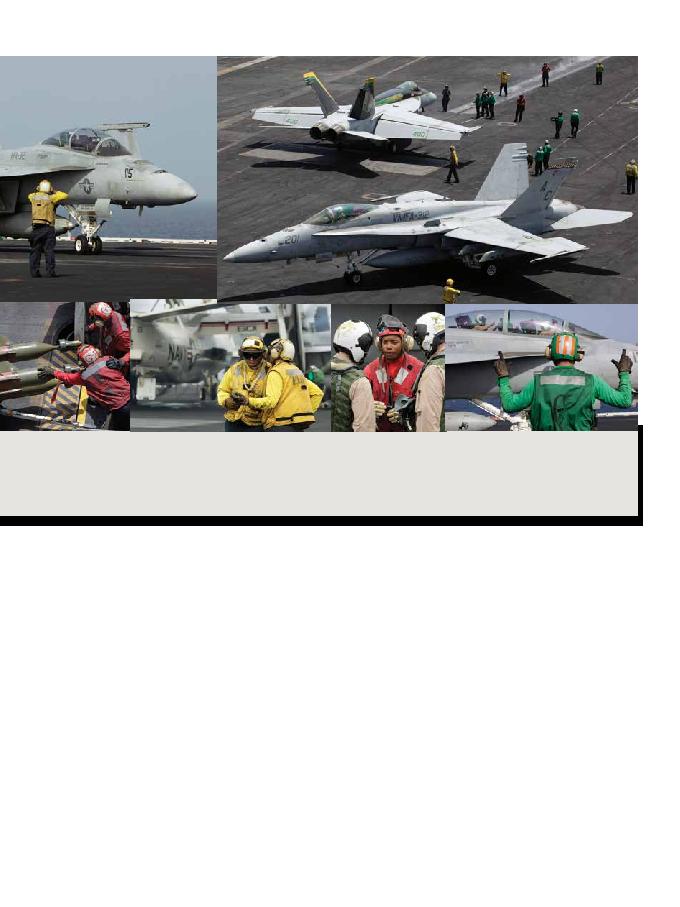
4. GREEN: All green crew are mainly responsible for air wing
maintenance and Helicopter Landing Signals enlisted personnel.
5. BROWN: All brown crew are the Air Wing plane captains
and Air Wing line leading petty officers.
6. All green is responsible for Catapult and Arresting Gear,
air wing maintenance and Helicopter Landing Signals
enlisted personnel. Last gear check before launching.
7. Ordnance crews (red) with GBU-12 Paveway II. Load
and arm these weapons on the aircrafts.
8. YELLOW: All yellow crew are responsible for aircraft handling
(handlers), catapult and arresting gear and could be the plane directors.
9. Last information from an ordnance crewmember before starting up.
10. The `Shooters' give the signal that the aircraft is ready for `launch'. The
catapult operator then activates the mechanism causing the aircraft to
lift off from the flightdeck with approximately 280 kilometers per hour.