24
GA
/ Vol. 5 / No. 3 / MARCH 2013
Technology
Rolls Royce
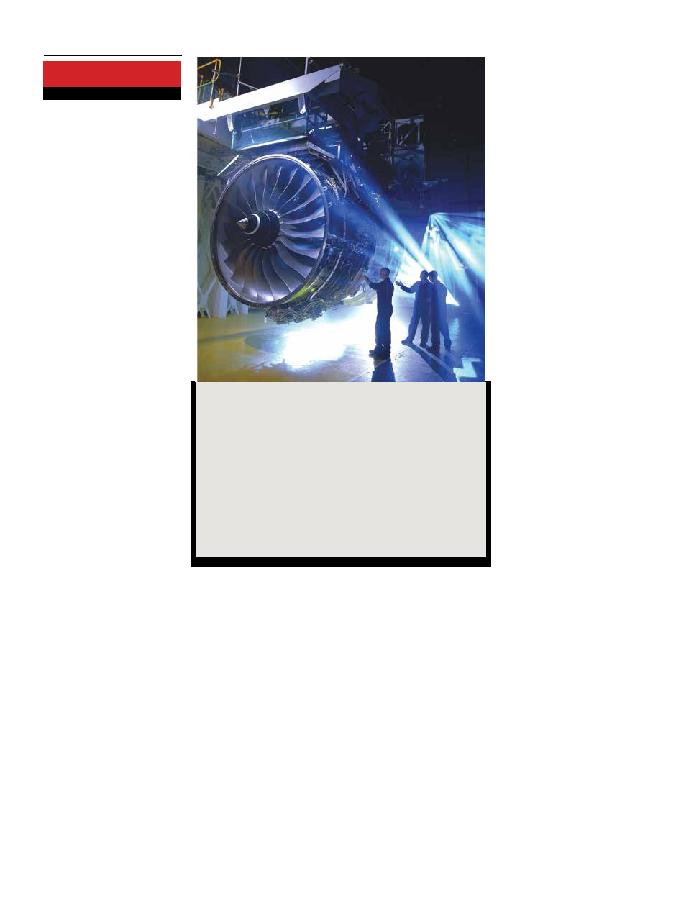
Trent 1000
Last month we looked at
a huge engine from GE,
the GE 90 this month
it's Rolls turn with the
RR Trent 1000. Yes its
designedly much smaller
than the GE 90 but has
some very interesting
technology incorporated
including a bleedless
system and a very
high by-pass ratio.
Design and development
During 2004 Boeing announced that
it had selected two engine suppliers
for its new B787: Rolls-Royce
(RR) and General Electric (GE).
Initially, Boeing toyed with the idea
of sole sourcing the powerplant for
the 787, with GE being the most
likely candidate. However, potential
customers demanded choices and
Boeing relented. For the first time
in commercial aviation, both engine
types will have a standard interface
with the aircraft, allowing any 787
to be fitted with either a GE or
Rolls-Royce engine at any time as
long as the pylon is also modified.
RRs partnered with risk and
revenue sharing partners on the
Trent 1000 program. This time
there were six partners: Kawaski
Heavy Industries (intermediate
compressor module), Mitsubishi
(combustor and low pressure
turbine blades), Industria de Turbo
Propulsores (low pressure turbine),
Carlton Forge Works (fan case),
Hamilton Sundstrand (gearbox) and
Goodrich (engine control system).
Altogether, these partners have a
35 percent stake in the program.
In June 2004, Air New Zealand
became the first airline to choose
the engine who chose the Trent
1000 for its two firm orders. In the
largest 787 order, that of Japan's
All Nippon Airways, Rolls-
Royce was selected as the engine
supplier on October 13, 2004.
The Trent 1000 was the launch
engine on both currently planned 787
models, the -8 with ANA and the -9
with Air New Zealand. On 7 July
2007, Rolls Royce secured its largest
ever order from an aircraft leasing
company when ILFC placed an order
worth $1.3 billion at list prices for
Trent 1000s to power 40 of the 787s
which it has on order( $16.25 m per
engine, which is 22% of airplane
price), and on 27 September 2007
British Airways announced the
selection of the Trent 1000 to power
24 Boeing 787 aircraft. The Trent
1000's share of the B787 market was
40% at the end of August 2008.
The Trent 1000 family makes
extensive use of technology derived
from the Trent 8104 demonstrator. In
order to fulfill Boeing's requirement
for a "more-electric" engine, the
Trent 1000 is a bleedless design, with
power take-off from the intermediate-
pressure (IP) spool instead of the
high-pressure (HP) spool found in
other members of the Trent family.
A 2.8 m (110 in) diameter swept-
back fan, with a smaller diameter
hub to help maximize airflow, was
specified. The by-pass ratio has been
increased over previous variants by
making adjustments to the core flow.
A high pressure ratio along with
contra-rotating the IP and HP spools
improves efficiency, and the use of
more monolithic parts reduces the
parts count to minimise maintenance
costs. A tiled combustor is featured.
The first run of the Trent 1000
was on 14 February 2006, with first
flight on Rolls-Royce's own flying
testbed (a modified Boeing 747-200)
successfully performed on June 18,
2007. The engine received joint
certification from the FAA and EASA
on 7 August 2007 (7-8-7 in the UK).
The initial design failed to meet
the Boeing required specific fuel
consumption (SFC). However, entry
into service was delayed, following
a series of setbacks to the Boeing
787 airframe program, allowing two
redesign packages to be incorporated
into the test program which are said
to improve the SFC (specific fuel
consumption) by 3-4% to bring it
to within 1% of specification. On
October 26, 2011, the 787 flew its
first commercial flight from Narita to
Hong Kong on All Nippon Airways.
powered by Trent 1000 engines. ·
General characteristics
Type: Three-shaft high bypass ratio (11-10.8:1) turbofan engine
Length: 4.738 m (186.5 in)
Diameter: 2.85 m (112 in) (Fan)
Dry weight: 5,765 kg (12,710 lb)
Components
Compressor: Single stage LP, eight-stage IP, six-stage HP compressor
Combustors: Tiled combustor
Turbine: Single-stage HP turbine, single-stage IP turbine,
six-stage LP turbine
Performance
Max thrust: 53,00075,000 lbf (240330 kN) (flat-rated to ISA+15C)
(Takeoff thrust)
Overall pressure ratio: 52:1 (Top-of-Climb)
Thrust-to-weight ratio: 6.189:1 (Trent 1000-J/-K at maximum thrust)
Soloy Aviation Solutions has
engineered and received STC
approval for a LED based aircraft
lighting kit for the Cessna 206G
and 206H model aircraft.
The kit installs a second light
source on the leading wedge of
the right wing to complement the
factory installed left wing taxi
and landing lights. The kit further
converts both sides to LED
illumination, creating significant
visibility improvement in taxi
and landing environments and is
compatible with the 50 gallon fuel
tanks from Sierra Industries.
Additionally, Soloy's new
kit includes pulse light capability
pulsing the landing light between
the two wings. This pulse feature
will greatly enhance recognition
and visibility from other aircraft
in high traffic environments.
Each wing will retain its two
light bulb configuration. The taxi
light uses a diffused lens to cast wider
light during taxi operations while the
landing light projects a much narrower
but far more penetrating beam than
the current landing light bulb.
The Sunspot 36HX lights used
are from AeroLED and deliver 1000+
lumens at 45W which is comparable to
a 100W halogen but at half the required
power needed. The LED bulbs are
rated for 50,000 hours of operation.
Pricing for the new kit is
$6,700.00 and Soloy anticipates
first deliveries in April 2013.
New Soloy LED
Landing Light Kit
Enhances Visibility
& Safety for Cessna
206 Aircraft
Aviation turbine
fuel (jet fuel
CIVIL JET FUELS
Aviation turbine fuels are used
for powering jet and turbo-prop
engined aircraft and are not to be
confused with Avgas. Outside former
communist areas, there are currently
two main grades of turbine fuel in
use in civil commercial aviation :
Jet A-1 and Jet A, both are kerosene
type fuels. There is another grade
of jet fuel, Jet B which is a wide
cut kerosene (a blend of gasoline
and kerosene) but it is rarely used
except in very cold climates.
JET A-1
Jet A-1 is a kerosene grade of fuel
suitable for most turbine engined
aircraft. It is produced to a stringent