30
GA
/ Vol. 5 / No. 3 / MARCH 2013
counterpart of the well known GCA
(Ground Controlled Approach).
During all recovery scenario's
the most difficult part of the
approach starts when the pilot
has the `Meatball' in sight. This
`Improved Fresnel Lens Optical
Landing System' (IFLOLS) is of
crucial importance and helps the pilot
during the last phase of the approach
procedure. It is roughly comparable
with the Precision Approach Path
Indicator (PAPI)system that is often
used on shore based airfields. A stack
of 12 light cells is producing a single
ball-shaped image. The pilot must
make sure to have this meatball in
the middle of a row of green lights.
When flying above the glidepath the
meatball will appear above the row of
green lights, and when flying slightly
below it will appear below the green
bar. When flying dangerously low the
pilot will just see a red line of lights
on the IFLOLS. During the last visual
phase of the approach the pilot is
assisted by a Landing Signal Officer
(LSO) or `Paddles' This usually
is a pilot belonging to the same
squadron as the approaching pilot is.
Standing next to the runway he is in
permanent contact with the pilot via
radio and light signals while using
the `Integrated Launch And Recovery
Television Surveillance System'
(ILARTS) that provides detailed
1
3
4
5
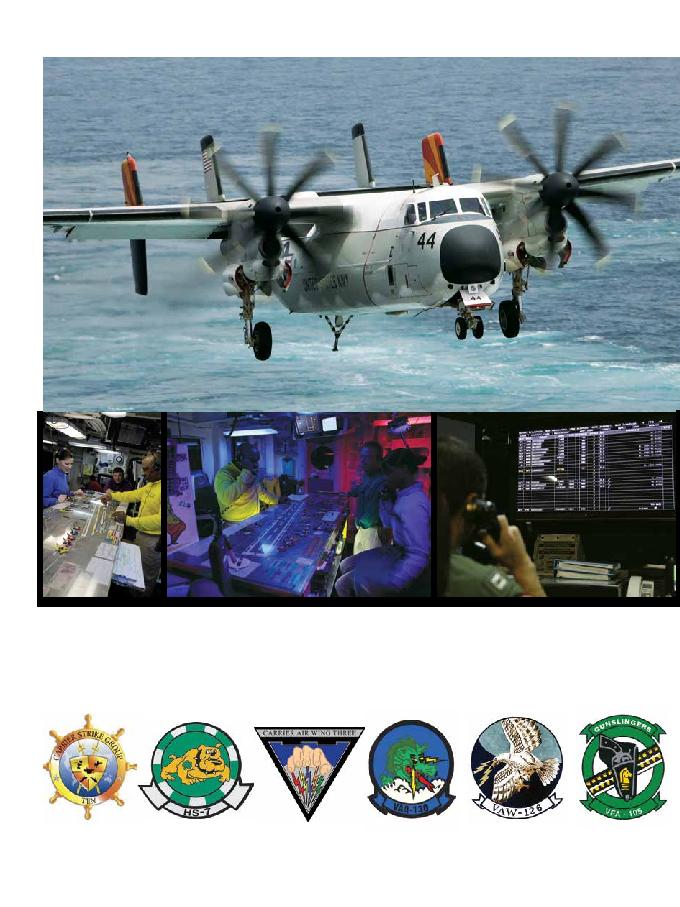
1. Carrier Strike Group Ten 2. HSC-7 Helicopter Sea Combat Squadron Seven 3.Carrier Air Wing Three "Battle Axe" 4 Electronic Attack Squadron 130 (VAQ-
130) "Zappers" 5. Carrier Airborne Early Warning Squadron 126 "Seahawks" 6 Strike Fighter Squadron 105 (VFA-105) "Gunslingers" 7. Strike Fighter.
1
2
3
4
5
6