32
GA
/ Vol. 5 / No. 3 / MARCH 2013
will give maximum power in case he
misses all cables, also called `Bolter',
providing enough speed to perform a
touch and go and do a second landing
attempt. After landing the arresting
cable is quickly disconnected
from the tailhook and the aircraft
taxies to an assigned parking spot
enabling the next aircraft coming
in to land. `A landing on an aircraft
carrier, especially during night
time operations, is very demanding
both mentally and physically.
Therefore a pilot of the US Navy
or US Marines Corps must train
carrier deck landings regularly to
maintain his `Carrier Qualification',
explains Lieutenant Jason Heath of
VFA-32 `Fighting Swordsmen'.
Updates are essential
During recent years the US Navy has
undergone significant renovations.
In 2006 the F-14 Tomcat was finally
retired from service in favour of
the more versatile and 40% more
economical Super Hornet. The S-3
Viking was also not able to escape
budget cuts and the modernization
program of the US Navy when the
last one was retired from active
carrier service in 2009. One of her
notable tasks: -air-to-air refuelling-
was taken over by the F/A-18F Super
Hornet. Another type of aircraft
that will hand over it's tasks in the
near future is the EA-6B Prowler.
Although the aircraft have recently
been fitted with the AN/ALQ-218
`Tactical Jamming Receiver' and
the `Multifunctional Information
Distribution System' (MIDS)
Link-16 system which should allow
the Prowler to fly well into the
next decade, it's replacement: the
Boeing EA-18G `Growler' will
gradually take over the tasks of
the EA-6B Prowler when the last
of the 88 ordered airframes have
been delivered according schedule
in 2013. The U.S. Navy is very
pleased with the versatility of the
Super Hornet fleet and they are
being upgraded continuously with
the newest systems like the: -`Joint
Helmet-Mounted Cueing System'
(JHMCS), -AN/ASQ-228 `Advanced
Targeting For ward Looking Infrared'
(ATFLIR), -ASD-12V `Shared
Reconnaissance Pod' (SHARP),
-` Integrated Defensive Electronic
Countermeasures System' (IDECM)
consisting of the AN/ALQ-165,
AN/ALQ-214 and ALE-50/55
`Towed Decoy , -and the new
APG-79 `Active Electronically
Scanned Array' (AESA)radar.
Due to these ongoing updates
and implementations the Super
Hornet will remain the figurehead
of the carrier fleet at least until
2025 when the F-35C Joint Strike
Fighter will gradually replace it.
Strategically vital
"The U.S. Navy aircraft carriers have
become indispensable. They can
operate independently throughout
the world, and are often first on
the scene', explains Commander
Air Group (CAG) CVW-3 Captain
James 'Spock' Bynum out proudly.
"In each operation or conflict aircraft
carriers play a key role, like over
Afghanistan. We are able to reach
our mission area in less than half
an hour from our position in the
Arabian Sea. This deployment is
intensively trained for. In particular
the cooperation and communication
between the many coalition troops
both in the air and on the ground
makes it a huge challenge and
demands intense coordination.
Using the new ATFLIR, SHARP
reconnaissance-pod and the
'Remotely Operated Video Enhanced
Receiver (ROVER) during our
missions enables a more efficient
data exchange between aircraft
overhead the mission area and the
"Joint Tactical Attack Controller'
(JTAC) providing optimal Close
Air Support (CAS) to our coalition
troops. " Since the USS Truman
entered service in 1998 it has
participated in numerous operations
including 'Southern Watch', 'Iraqi
Freedom' and currently 'Enduring
Freedom' over Afghanistan.
The USS Truman played an
important role as well during the
humanitarian operations in the wake
of Hurricane Katrina in 2005. "At
this moment another aircraft carrier:
the USS Peleliu (LHA-5) with 19
helicopters aboard (CH-53E Super
Stallions and CH-46E Sea Knights)
is contributing to the humanitarian
operations following the floods in
Pakistan ' says Captain James Bynum.
"Another important task of the Carrier
Strike Group is to protect sea and air
routes. USS Truman and CSG-10 are
covering a large area ranging from
the Persian Gulf to a large part of the
Indian Ocean. Every day we fly about
60 missions, but if necessary this
can be raised up to 120. That is more
than an average Air Force flies in one
day, "Captain James Bynum laughs.
"But everything stands or falls with
the commitment of the crew. They
are eight months away, and we do
everything to keep them motivated
by having their own TV station, a
newspaper and many other facilities
on board. Through our independence
we make the difference!' ·
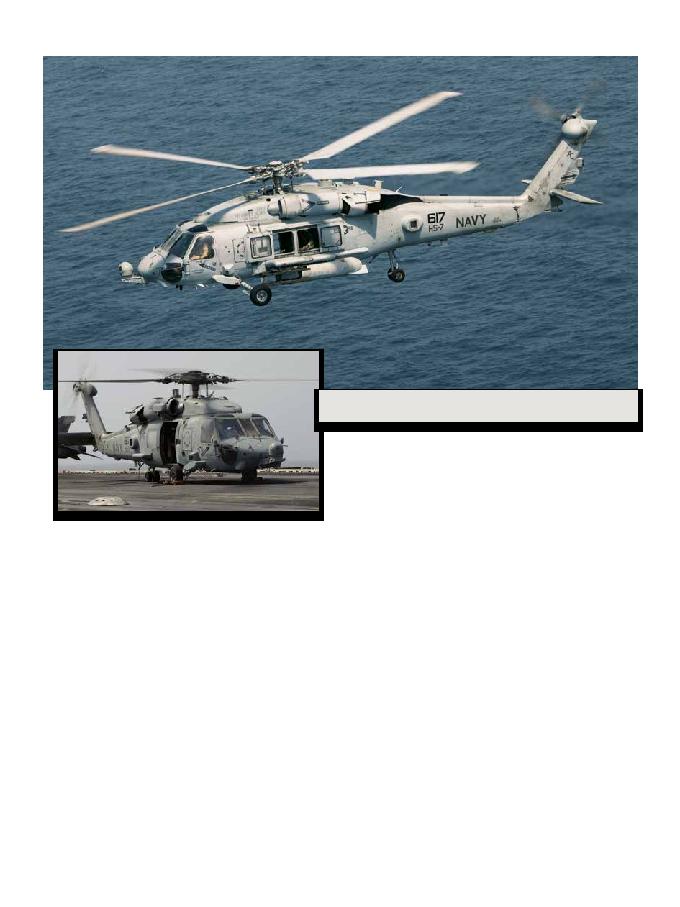
Seahawk Dusty 617 is scrambled for a medical evacuation (MEDEVAC)
flight to Muscat, Oman.