12
GA
/ Vol. 5 / No. 3 / MARCH 2013
In an ironic twist, the Boeing
Dreamliners may be grounded for
weeks to come, but the lithium ion
batteries have now been exempted
from the ban which prohibited
them from being carried as cargo
on flights by passenger planes.
When the US government
certified the Boeing 787 as safe,
federal rules barred the type of
batteries used to power the airliner's
electrical systems from being
carried as cargo on passenger
planes because of the fire risk.
Now the situation is reversed
which in effect means the
Dreamliner's batteries are now
allowed to fly only if they're
not attached to a Dreamliner.
Dreamliners worldwide were
grounded in January after lithium ion
batteries that are part of the planes,
led to a fire in one plane and smoke
in a second. But new rules exempt
aircraft batteries from the ban on
large lithium ion batteries as cargo
on flights by passenger planes. The
rules were published on the same day
as a battery fire in a Japan Airlines
787 parked at Boston's Logan
International Airport took firefighters
nearly 40 minutes to put out.
A report in Associated Press
indicates that pilots and safety
advocates say the situation doesn't
make sense. If the 787's battery
system is too risky to allow the planes
to fly, then it's too risky to ship the
same batteries as cargo on airliners.
"These incidents have raised the
whole issue of lithium batteries and
their use in aviation," said Jim Hall,
a former National Transportation
Safety Board chairman. "Any
transport of lithium batteries on
commercial aircraft for any purpose
should be suspended until (an) NTSB
investigation is complete and we
know more about this entire issue."
The battery rules were changed
in order to conform U.S. shipping
requirements with international
standards as required by Congress,
according to a statement by the
federal Pipeline and Hazardous
Materials Safety Administration.
The International Civil Aviation
Organization adopted the aircraft
battery cargo exemption in October
2011, and it went into effect January.
1. Previously, U.S. regulations
prohibited the shipment of lithium
ion batteries on passenger planes
in packages weighing more than 11
pounds, although heavier batteries
could be shipped on cargo planes.
Batteries can fly
Dreamliner can't
Airline News
The new rules allow the shipment
of lithium ion batteries weighing as
much as 77 pounds, but only if they
are aircraft batteries. Shipments of
other lithium ion batteries greater
than 11 pounds are still prohibited.
The 787's two batteries weigh 63
pounds each. It's the first airliner
to make extensive use of lithium
ion batteries, which weigh less
and store more power than other
batteries of a similar size.
The aircraft battery exemption
was created for the convenience of
the airline industry, which wants to
be able to quickly ship replacement
batteries to planes whose batteries are
depleted or have failed. Sometimes
it's faster to do that using a passenger
plane. The International Air Transport
Association (IATA), which represents
U.S. airlines and other carriers that fly
internationally, asked for the aircraft
battery exemption at the October
2011 meeting of the UN agency's
dangerous goods committee.
The association argued that
the exemption would give airlines
"significant operational flexibility in
being able to move aircraft batteries
on a passenger aircraft where cargo
aircraft may not be available over the
route, or within the time required if
a battery is required at short notice,"
according to a copy of the request
obtained by The Associated Press.
Since the batteries have to meet
special safety standards in order to
be installed on planes, "it is believed
that exceeding the (11-pound)
limit for passenger aircraft will not
compromise safety," the request said.
Some members of the committee
opposed allowing shipments of lithium
ion aircraft batteries on passenger
planes, saying safety regulations
that let the batteries be used onboard
planes don't necessarily ensure they
can be transported safely as cargo,
according to a summary of the meeting
posted online by the UN agency.
The Japan Airlines fire ignited
about half an hour after the plane
had landed in Boston and nearly
200 passengers and crew members
had disembarked. Firefighters were
alerted after a cleaning crew working
in the plane smelled smoke.
The use of lithium ion batteries
is not restricted to Boeing as the
Airbus A350, expected to be ready
next year, will also make extensive
use of lithium ion batteries.
Aircraft manufacturers are
also considering retrofitting some
planes to replace their batteries with
lithium ion batteries to save weight,
according to the airline association.
The less a plane weighs, the less
fuel it burns. Fuel is the biggest
operating expense of most airlines.
Cargo airline pilots long have
complained about the dangers of
transporting lithium batteries. The
batteries are suspected of causing
or contributing to the severity
of an onboard fire that led to the
September 2010 crash of a United
Parcel Service plane near Dubai,
killing both pilots. The two pilots of
another UPS plane barely managed
to escape the aircraft before it was
consumed by fire moments after
landing in Philadelphia in 2006.
Lithium-ion batteries can
short circuit and ignite if they are
improperly packaged, damaged or
have manufacturing defects. Fires
involving rechargeable lithium-
ion batteries can reach 1,100
degrees, close to the melting point
of aluminum, a key material in the
construction of most airliners. ·
More than 50 business people
attended the sixth annual event
for bankers, investors and airline
executives where the focus
fell on Africa's role in regional
financing as interest among banks,
investment funds continues to rise.
Africa's long anticipated
economic growth is driving rapid
evolution of its aviation sector and
attracting considerable interest
among financial institutions, aircraft
maker Boeing reported at its largest-
ever event for African financiers
entering into or expanding large
commercial aircraft investment.
The round table event held early
in February attracted executives
from the continent's banks, financial
institutions including HSBC Bank,
Investec Bank, Nedbank Capital,
Rand Merchant Bank, Standard
Bank of South Africa, Stockwell
Holdings and Via Capital and
about 10 of the continent's airlines
and aircraft leasing firms.
"Our event in 2008 drew about
20 participants. This year's session
saw more than 50 attend," said Ron
Glover, managing director for the
region in Boeing Capital Corporation,
the manufacturer's aircraft financing
and leasing unit, and the event's
host. "It's a sure sign of the
popularity and increased awareness
by African investors of the very
attractive investment opportunity that
commercial airplanes represent."
Financiers attending heard
from the jet maker about global
air travel trends, the company's
product line of new, fuel efficient
jetliners, aircraft financing market
conditions and Africa's air-travel
prospects among other topics.
The audience represented
banks and financial institutions.
As the second largest and
most populated continent after
Asia, Africa's economic potential
remains strong, with the region
Record Boeing Aircraft Bank event reflects Africa's
rapid economic growth
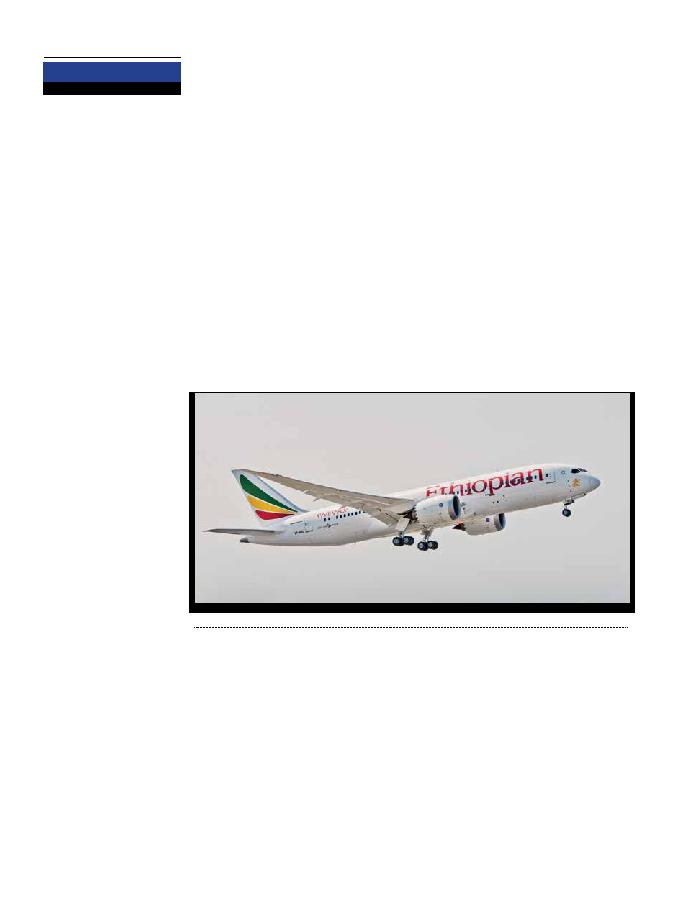
A Boeing 787, Dreamliner belonging to Ethiopian Airlines..