10
GA
/ Vol. 5 / No. 3 / MARCH 2013
Airline News
Dogs and birds
at King Shaka
Marius van Rooyen, head of environ-
mental affairs at King Shaka Interna-
tional airport recently showed Global
Aviator's correspodent, Might Wright,
how they control birds at KSIA using
specially trained Border Collies.
Marius was born in East London and
matriculated from the George Randell
High School in East London.
He has always had a passion for
dogs and animals in general and
became more involved when he was
an Airport Fire Fighter and found
an interest in birding, soon starting
to identify birds by calls and sight.
Marius was the first person in ACSA,
SA and in Africa to operate a dog on
the airfield at the old Durban Interna-
tional Airport.
"Bird control is not just chasing
birds off the runway, but more Bird &
Wildlife Management. This is where
you identify potential hazardous areas
in and around your airfield." he says.
"One has to be proactive and reactive.
Bird control has grown over the years.
Gone are the days of just chasing
birds away. We need to think outside
the box and beat them to it (that is the
birds). It is always a challenge to do
this type of work and you learn some-
thing new every day. My concern is
the safety of aircraft and passengers"
he added.
Designated examiner
Marius is a Designated Examiner for
PARTAC practical's, testing all new
PARTAC staff that operate on the
airfield. Permission was granted by
CAA and ATNS for Marius to test
candidates in 2010.
"I will ask them a few questions
and mark them while driving and
talking to Ground and Tower. They
need to score 75% to pass and also
at my discretion. If the person is not
100% confident then I cannot allow
him or her on the airfield and also
not issue his license card. They will
have to return when they are more
confident." Everyone does a five day
theory PARTAC course through their
training academy and then Marius
gets involved by testing them on the
airside for the practical's.
Wildlife at KSIA
When the Airport started opera-
tions in 2010 there was not much we
could do before completion and only
afterwards could we purchase humane
traps for wildlife and try to remove
whatever we could. We are planning
to close all of the FOD/water holes
around the fence which allows small
wildlife like rabbits, mongoose, etc
to come and go as they please which
could be a threat to aviation and cer-
tainly to the animal."
They are trying out a new one
way flap, so that if any animal needs
to get out, the valve would open and
shut behind them. It cannot be opened
from the other side at all. That is the
project for the next few months. "It
has been very difficult to try and trap
them and relocate them outside the
airfield area, only for them to re-enter
again." he says.
The entire Bird and Wildlife
team have been on a Snake Handling
course, where they had to handle 4
dangerous snakes, as part of their
course and exams, namely Puff Adder,
Spitting Cobra, Cape Cobra and the
Rinkhals. They do have the odd oc-
casion to catch snakes on the airfield,
mostly the Black Mamba and they
relocate them in close co-operation
with the local authorities.
Border collies
Collies are very energetic and hard
workers, known for their high degree
of intelligence and their ability to work
tirelessly, needing only 5min to rest
before continuing again. They can
work in almost any weather condi-
tions and are used to control birds and
wildlife.
"Let me say that they do not go in
for the kill on any bird. They are not
trained to do that. Most importantly,
they are `silent' workers and don't bark
while chasing." They have a life span
of around 14-15 years and can start
working from 1 year of age.
Bird patrols
"KSIA have set up a morning patrol,
which is High Risk, as this is the
time when most birds if not all, are
active and it is up to us to harass any
unwelcome bird or flock of birds on
the airfield. This could take them any-
thing from 1 to 3 hours at time. They
cover around 8 hours (average) of bird
patrols every day from 06h00 to 18h00
and if necessary beyond 18h00 if there
are any bird issues until sunset.
Bird strikes
We asked Marius whether they had
experienced any bird strike incidents
at this stage. "Yes, we had a few.
Every year we have an average of 30
to 40 bird strikes. We had one major
incident when an aircraft took off and
a flock of 6 or so Black-headed Herons
flew in and landed in front of the
aircraft." This is unfortunately beyond
our control, and two went through the
engine. It damaged 9 blades, but the
aircraft concerned landed safely at
the end.
Barn swallows and the
bird radar
The Barn Swallows have a roosting
area about 3km away from the one
threshold and about 90m below sea
level. The radar is there to detect
any danger, in other words, if they
penetrate a certain area where aircraft
are coming in to land, control would
get an alarm which is linked to ATC.
They can then notify ATC of their
height and distance from the end of
the threshold.
This will then be passed on to any
landing aircraft. Once they go below
that section, it will change from red
to orange and then back to Green,
which means all clear. There are 3
stages: green for all clear, an orange
bar warning us it might become red,
be alert, and then Red which means
warning/caution.
Someone monitors the radar daily,
in swallow season which is around end
October until beginning April at the
latest. There are times that they are ac-
tive and that is early morning (sunrise)
for about 5 to 10min maximum and
then late afternoon from about 2 hours
before sunset. The main concern is
late afternoon when the birds are more
active and every swallow is coming in
from all over to rest for the evening.
In the early mornings it is quick. They
leave in 3 stages in that short window
of time and don't hang around the reed
bed area at all. ·
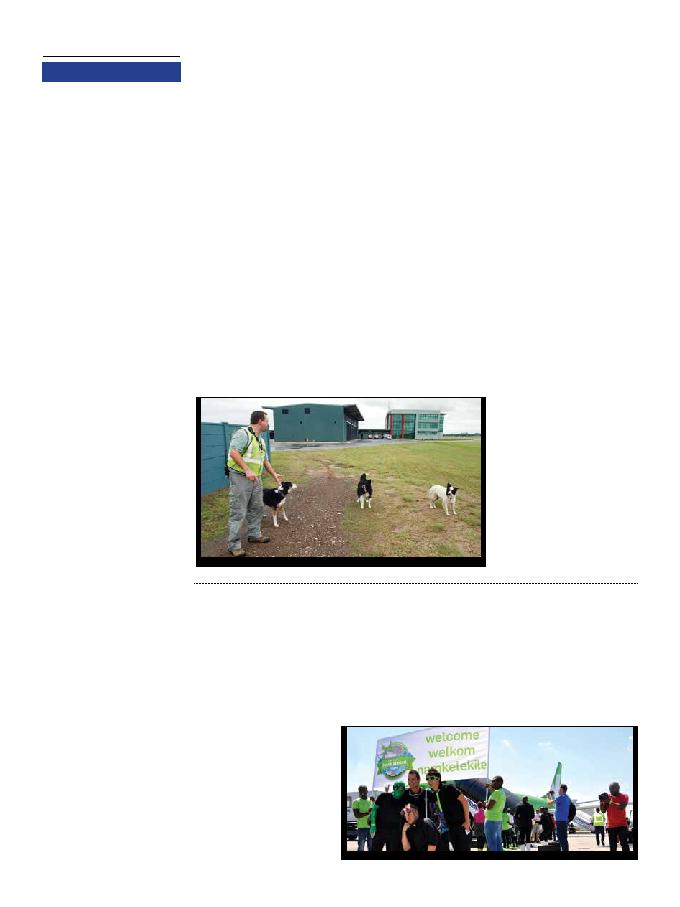
Marius van Rooyen with the Border Collies he uses to control birds at KSIA.
January 26 saw a wildly diverse mix
of ordinary and extraordinary South
Africans make history by jetting off
on `The Most South African Flight
Ever', orchestrated by South African
airline, kulula.
The unique 189 individuals chosen
to represent their tribes on the momen-
tous, never-been-done-before flight
indulged in a morning of all things
South African. In the departure hall
they were entertained by an array of
proudly South African acts, which in-
cluded some power-dressing gumboot
dancers, a contortionist, a magician,
puppeteers and soccer ball tricksters.
After entering the boarding gates, the
entertainment continued as surprised
passengers and airport staff were
treated to a musical set by zef-rapper,
Jack Parow.
On the flight from Lanseria to
kulula's purely South African flight
Lanseria, passengers enjoyed a scenic
tour of the Johannesburg skies, while
being entertained by MC and come-
dian, Kurt Schoonraad. No South
African flight would be complete
without the National Anthem, so a
pop-up choir scattered throughout the
plane surprised passengers with their
rendition. "kulula, has grown from
nothing to what it is today by flying
South Africans from all walks of life,
all around the country, day in, day
out. So to celebrate this and kulula's
passion for travel, we orchestrated
this fun momentous flight to celebrate
with our fans," says Nadine Damen,
Marketing Manager for kulula.com.