28
GA
/ Vol. 5 / No. 3 / MARCH 2013
Impressive sight
W
ith a length of 334
metres, 76,5 metres of
width, a height of 20
stories and a surface
measuring 18.211 square metres, the
USS Harry S. Truman can truly be
called an impressive colossus. It was
commissioned on the 25th of July in
1998 as the eight ship of the so called
`Nimitz-class'. It contrary to it's con-
ventional predecessors energy is gen-
erated by two Westinghouse nuclear
reactors who in turn provide energy
to propel the four five bladed screws
that gives the USS Truman a maxi-
mum speed of well beyond thirty
knots. During an operational deploy-
ment having the complete `Carrier
Air Wing Three' on board consisting
of the following flying units: HS-7
`Dusty Dogs' (H-60 Sea Hawk),
VFA-32 `Fighting Swordsmen' (F/A-
18F Super Hornet), VFA-37 `Ragin
Bulls' (F/A-18C Hornet), VRC-40
det.1 `Rawhides' (C-2A Greyhound),
VFA-105 `Gunslingers'(F/A-18E
Super Hornet), VAW-126 `Seahawks'
(E-2C Hawkeye 2000), VAQ-130
`Zappers' (EA-6B Prowler), and
VMFA-312 `Checkerboards' (F/A-
18C Hornet), the ship counts around
5.000 military personnel and having
approximately 80 aircraft on board.
An oiled structure
The flight deck is a dynamical stage
where besides the many aircraft, the
colourfully dressed crew attracts
attention. Although looking somewhat
disorderly at times, everyone on the
flight deck has a clearly outlined task
which functions altogether like a well
oiled machine. Daily routine starts at
6 o'clock when the greater part of the
ship's crew awakes. Not much later
all flight crew gathers on the flight
deck to do the `FOD-Walkdown'.
Side by side the deck is thoroughly
examined for `Foreign Object Debris'
which can cause in turn `Foreign
Object Damage' (FOD) to engines of
the aircraft. When the flight deck is
considered clean, preparations starts
for the daily missions. While pilots
receive their tactical briefings, red
dressed Aviation Ordnance Personnel
or `Ordies' are busy loading all fighter
aircraft with AIM-9X Sidewinders,
GBU-38 JDAM's , GBU-12 Paveway
II LGB's , en Mk.82's. Purple coloured
refuelling personnel or `Grapes'
are topping off the aircraft with the
requested fuel for their mission while
brown coloured crewchiefs do the
last technical checks before wiping
the windshield clean to give the pilot
an impeccable sight during take-off
and landing. On the other side of the
flight deck, where it is already 45
degrees Celsius in the early morning,
green coloured catapult operators are
preparing the four steam catapults and
the four cable barrier's for landing.
Half an hour before the start of
the first flying `Cycle', pilot's emerge
from their briefing rooms and walk
to their aircraft to do the pré-flight
checks. The first aircraft to start up
their engines are the SH-60F and
HH-60H Seahawk helicopters of HS-
7. They need to be airborne during
launch and recovery of the aircraft
in case a pilot ditches into the sea
after a failed catapult launch or failed
recovery. Prior to the launch of the
`fighter wave' an E-2C Hawkeye
2000 is being launched from the
Truman to act as an Airborne
Early Warning and Control Post.
Preparations for launch are always
done with ultimate precision which
already starts when the first aircraft
taxies out from it's parking spot.
Yellow coloured Plane Directors
or `Marshallers' are guiding the
aircraft over the busy flight deck.
Despite all carrier based
aircraft have foldable wings, there
is sometimes no more separation
than halve a meter between one
and the other aircraft on the flight
deck while underway to the steam
catapult. Once having entered the
launchpad, the aircraft is lined up
and catapult officers or `Shooters'
are controlling the exact weight of
the aircraft. This exact weight is
crucial for the steam catapult settings.
Too little pressure will inevitably
result in a failed launch which will
cause the aircraft to ditch into sea.
Before being launched, the
launchbar on the nosewheel is being
lowered to connect with the shuttle
of the steam catapult. A `Holdback'
is connected to the rear side of the
nosewheel to prevent the aircraft
rolling forward while having it's
1
4
5
6
7
2
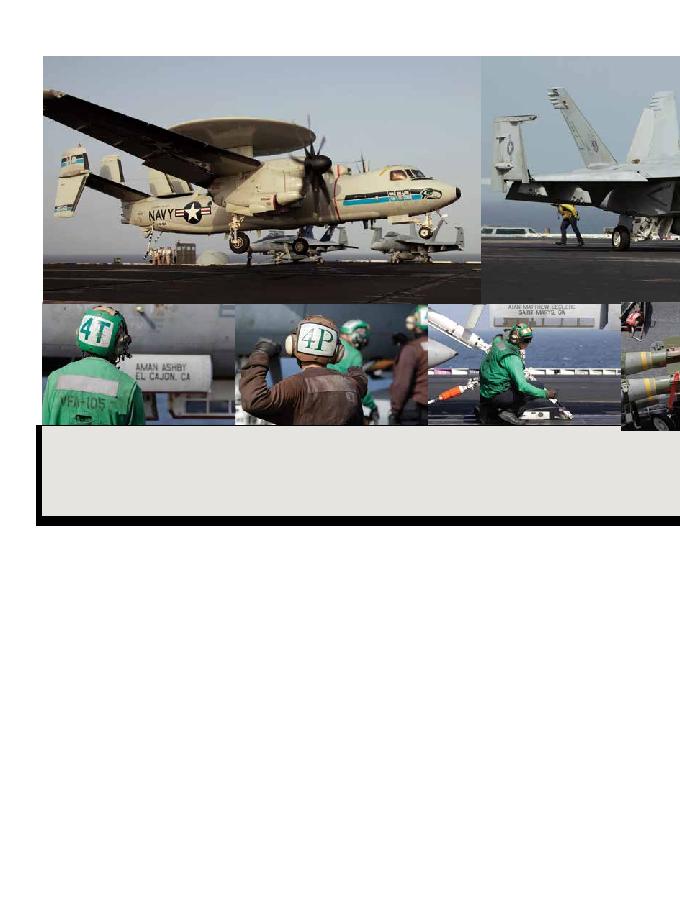
1. The most modern version of the Hawkeye currently in use is the E-2C
Hawkeye 2000 of which 26 are operational. Unlike earlier versions,
the "HE-2K" has an Improved Electronic Support Measures system
(ESM), Joint Tactical Information Distribution System (JTIDS),
Mission Computer Upgrade and Cooperative Engagement Capability
(CEC). The versions of the Hawkeye currently in use will be replaced
gradually from 2013 by the E-2D Advanced Hawkeye with stronger
AN/APY-9 Airborne Early Warning radar that can detect smaller
targets beyond the horizon and has a range of at least 500 km.
2. The U.S. Navy is very pleased with the Super Hornet, also
called "Rhino". Continuous upgrades will ensure that the F-18
will remain the backbone of the fleet for many years until the
F-35C JSF will gradually replace it in the next decade.
3. Operations aboard aircraft carriers go on, if needed, 24 hours a
day. Deck landings form a special challenge do the short length of
the landing area and the deck that is continuously in motion.