16
GA
/ Vol. 5 / No. 3 / MARCH 2013
by Mike Wright
Airline News
The value
of a good CRM
Captain Quentin Mouton, Mango's
chief pilot is a man who has flow just
about every aeroplane SAA have
ever possessed right up to the giant
B747-400. Those of you who read last
months magazine will have seen his
views on in flight upsets.
This month we had a chat to him
about a topic which has become
extremely important worldwide being
CRM (Cockpit Resource Manage-
ment) and we thank him for sharing his
views with us.
Modern aviation CRM has proved
to be of utmost importance. It was in
response to a spate of accidents dec-
ades ago that seemed to point to pilot
error. What they found was that there
was a deficiency in the way the pilots
interacted with one another.
Also it became evident that the
Power Distance Index (PDI) played
a prominent role in most of these
events. Low assertiveness on the part
of first Officers was also identified as a
contributor. Specific training in these
skills was developed and became the
norm, it has evolved over time and has
become a specialised discipline.
We recently did a flight with Quentin
and Captain Mark Jones to Johannes-
burg and back in the a Mango B737-
800 and witnessed an amazing
level of teamwork.
Quentin says it is important that
crews should work together. They
should know what each other are
thinking and what they are planning.
To this extent thorough planning and
briefings have become the standard.
Adhering to SOP (Standard Operating
Proceedures) strictly is important.
When new pilots join Mango they
are subjected to a two day CRM
course just to get off on the right foot.
After that, CRM is reinforced during
the conversion course and all recurrent
simulator training.
Poor CRM behaviour is often evi-
dent when incidents are investigated.
Not following SOP and poor discipline
are also part of the problem.
"No airline is immune to these lapses
and we monitor operations all the time
to manage safety." Quentin ads.
In regard to authority gradient on the
flight deck - I noticed that the Mango
Captains seem to work very well with
their younger counterparts unlike
in some parts of the world where
accidents have been caused because
the first officer for example noticed a
problem but was too scared to speak
up, an example is the BEA Trident stall
crash at London Heathrow. Quentin
refers to this as PDI (Power Distance
Index). He says it was especially evi-
dent in the Asian airlines and is due the
strong culture of respect for elders and
superiors. Special emphasis is placed
on this aspect during CRM training.
SA has amongst the best pilots in the
world. It seems as though one can
ascribe this accolade to the brilliant
training - We asked him about ongoing
training at Mango. South Africa is well
known internationally for its highly
skilled pilots and superior training.
Their pilot training legacy came from
the RAF originally.
Of course training techniques have
evolved over time and SA ranks among
the best in the world. Mango has been
very fortunate to be able to tap into a
group of extremely experienced and
gifted instructors (mostly retired SAA
Captain/Instructor types)who made a
huge contribution to their standard of
operation he says.
In regard to new recruits he says
they are spoiled for choice these days
with an oversupply of pilots avail-
able. FOs (Flight Officers) typically
have over 2000hrs before we inter-
view them. Direct entry Captains
must have over 10000hs and more
than 2000hrs in command before
they will be considered."It must be
stressed that we will always look
for our own FOs to upgrade before
we consider direct entry captains."
he added.
Aviation has become very sophisti-
cated and automated through the use of
computers. It has exposed a whole new
set of skills and discipline.
It works in synergy with CRM
and Threat and Error Management
which can be the subject of another
discussion with hopefully Quentin
will do with us. ·
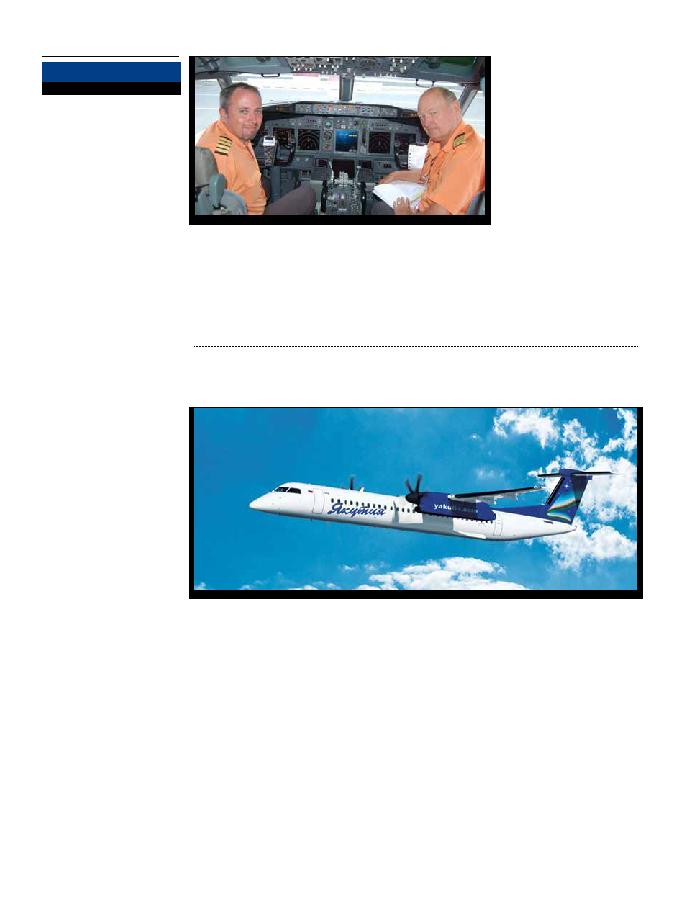
Captain Mark Jones left and Captain Quentin Mouton right in their office, the B737 800.
Montréal Aerospace will fly three
Q400 aircraft in Russia and the
Commonwealth of Independent
States (CIS).
Bombardier Aerospace welcomed
Yakutia Airlines to the growing
family of Bombardier Q400 aircraft
operators. Yakutia Airlines, a do-
mestic passenger carrier based in the
northeast region of Russia, will fly
three Q400 aircraft, with the first one
having arrived this week at Yakutsk
Airport.
Yakutia Airline's new status as a
Q400 aircraft operator follows the
type approval that was awarded in
June 2012 by the Interstate Aviation
Committee (IAC) - commonly known
by its Russian acronym, MAK. The
Q400 aircraft is the largest Western-
built turboprop aircraft to be awarded
type approval for operation in Russia
and the Commonwealth of Independ-
ent States (CIS).
"This marks a wonderful achieve-
ment and milestone for the Q400
aircraft program. We're proud to
welcome yet another new operator to
the family - Yakutia Airlines as the
first Russian-based operator," said
Mike Arcamone, President, Bombar-
dier Commercial Aircraft. "The Q400
aircraft is tailor-made for Yakutia
Airline's diverse route network that
provides regional airline service to
one of the largest territories in the
world," said Mr. Arcamone.
"The powerful, yet fuel-efficient
Q400 turboprop was selected for Ya-
kutia's operations because of its high
speed, which will allow us to cover
long sectors; its ability to operate on
unpaved runways; and importantly -
its capability in the difficult condi-
tions that northeast Russia presents,
including high winds and extreme
cold in the winter," noted Ivan Prostit,
General Director of Yakutia Airlines.
"We expect that the combination of
passenger comfort and low operat-
ing cost offered by the Q400 aircraft
will allow us to optimise our regional
operations."
Powered by two new-generation,
5,071-shaft horsepower (shp) PW150A
engines, and capable of flying at a
speed of up to 360 knots (667 km/h),
the Q400 aircraft can quickly climb
to turbulence-free altitudes, and can
also provide fast access to the remote
airports of the Siberian region of the
Russian Federation.
Bombardier has booked firm orders
for 463 Q400 and Q400 NextGen tur-
boprops, and delivered aircraft are in
service with more than 40 operators in
over 30 countries, on five continents.
These aircraft have transported more
than 243 million passengers and have
logged more than 3.8 million flight
hours and over 4.1 million take-offs
and landings. ·
Yakutia Airlines first to operate Bombardier
Q400 aircraft in Russia