18
GA
/ Vol. 5 / No. 3 / MARCH 2013
World News
Felix Baumgartner's supersonic
freefall from the edge of space
on October 14, 2012, reached an
even faster speed than originally
estimated: Mach 1.25. The statistic
was just part of the news shared
in a report detailing the results of
a three-month-long analysis of
mission data conducted by the Red
Bull Stratos science team, released
on Tuesday, February 5 this year.
The wide-ranging science
findings, including the first
physiologic data ever captured
from a human freefalling faster
than the speed of sound, also led to
some revisions in the initial figures
from the jump, which collected
knowledge for future aerospace
travel while breaking numerous
records. Baumgartner's record-
breaking maximum vertical speed
was revised upwards to 1,357.6
kmh / 843.6 mph / Mach 1.25 from
an initial estimate of 1,342.8 kmh/
833.9 mph/ Mach 1.24. With the
help of additional data recorder
analysis, the jump altitude was
revised slightly down to 38,969.4
m / 127,852.4 ft from the previous
estimate of 39,045 m/ 128,100 feet.
The most important finding of
the mission's analysis was already
abundantly evident to the countless
millions of viewers who watched
the leap live around the world.
The Austrian adventurer's freefall
demonstrated that, with the right
equipment and proper training, a
human being can safely accelerate
through the sound barrier. That is a
vital breakthrough for the aerospace
industry as it looks for answers to
the questions of crew and passenger
escape in emergency situations,
especially with commercial
space travel on the horizon.
"Together we proved that a
human in freefall can break the
speed of sound returning from near
space, going through a transonic
phase and landing safely on the
ground," said Dr. Jonathan Clark,
Red Bull Stratos Medical Director.
"That was a big part of the program,
and monitoring the mission was
a meaningful event in aerospace
medicine and physiology."
The documentation was finalized
after the mission's science team
conducted a private peer review,
the Red Bull Stratos Scientific
Summit, at the California Science
Center on January 23, 2013,
where the attendees included
NASA astronauts, U.S. Air Force
officers, and representatives from
commercial aerospace companies
such as Virgin Galactic, Northrop
Grumman, SpaceX, XCOR, Sierra
Nevada Corporation and more.
Also revealed were the final figures
submitted for records approval
including the slight upward revision
in Baumgartner's supersonic speed
Red Bull Stratos was a historic
mission to the edge of space in
which Baumgartner, a professional
BASE jumper, fulfilled a lifelong
dream: jumping from a capsule
that had ascended 39 kilometers /
24 miles above Earth, attached to a
helium balloon. He became the first
human to break the sound barrier in
freefall and established numerous
additional records in the process.
From its inception, the mission
was envisioned as a flight test
program for medical and scientific
advancement in human flight.
The release of findings from the
mission is the culmination of five
years of active flight test program
development, and topics range
from technical breakthroughs to
medicine and meteorology. Some the
most eagerly awaited information
was Baumgartner's preliminary
physiologic data, which includes
heart and respiratory rate at key
points during the ascent and record-
breaking freefall back to earth.
Baumgartner's physiologic
monitoring provided the team with
more than 100 million data points
Red Bull
Stratos
Releases final
data from
Baumgartner's
supersonic free-
fall to earth
including the first physiologic data
ever gathered from a human traveling
at supersonic velocity. The newly
released data not only includes his
heart and respiratory rate, but also
indicates the forces he encountered at
milestones throughout the mission.
Baumgartner's heartbeat reached
a maximum of 185 beats per minute
(bpm) when he exited the capsule
and ranged from 155 to 175 bpm
during freefall. Baumgartner, whose
heartbeat during the pre-launch
oxygen pre-breathe period was 40
to 100 bpm, had a heartbeat of 60
to 100 bpm during the ascent and
169 bpm when he hit Mach. 1.25
on the way back to earth, 155 to
180 during the parachute descent,
163 upon landing and 100 as the
recovery helicopter flew him back to
Mission Control. His respiratory rate
hit a maximum of 30 to 43 breaths
per minute during the freefall.
Baumgartner experienced 25.2
seconds of absolute weightlessness
during the initial stage of his
freefall. Subsequently, he entered
a period of turning and spinning
that reached a maximum rate of 60
revolutions per minute and put the
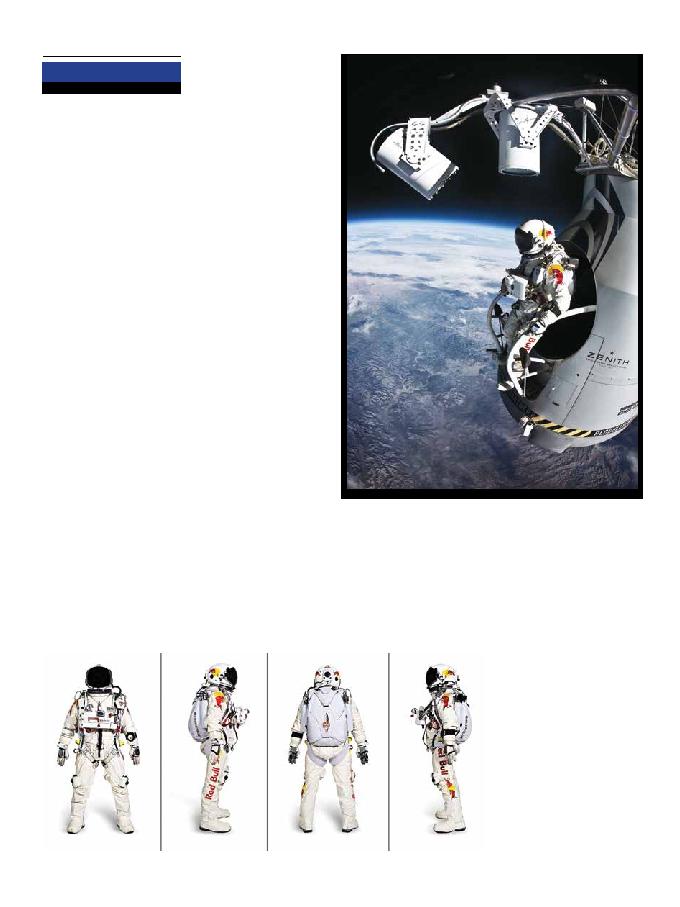
Felix Baumgartner's standing in the entrance to the capsule moments
before his supersonic free fall from the edge of space.