www.thebackdraftmagazine.com | A Volunteer Fire Service Publication | Volume 5 | Issue 1 | Backdraft Magazine 31
dams or absorbent pads. This also means
that when we apply a foam blanket to an
ethanol blended fuel (like any polar solvent),
it will readily pull the moisture from our
foam blanket, destroying it in seconds.
We must be mindful when inventorying
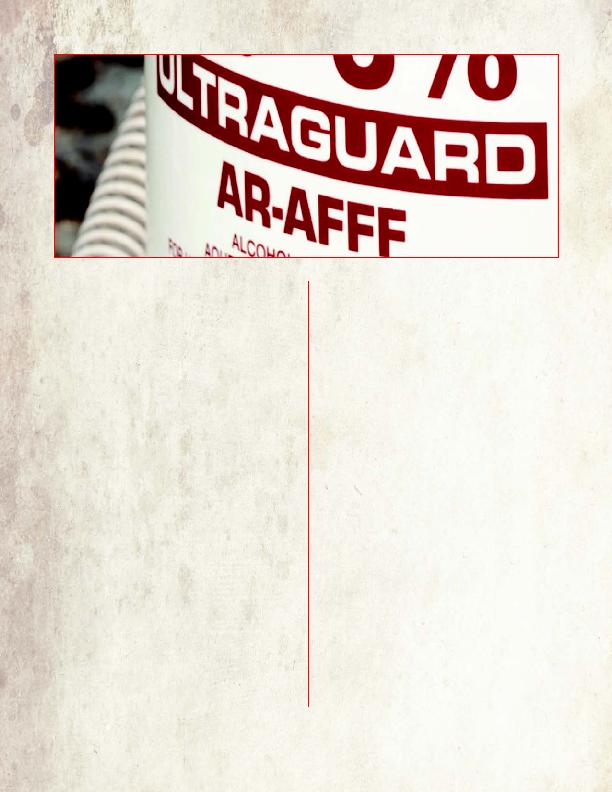
and purchasing foam that we have alcohol
resistant concentrates. The alcohol resistant
concentrates have an added polymer, which
forms a barrier to prevent the water from
being pulled from the foam blanket.
If the water is pulled from the foam blanket,
all effectiveness is lost and the foam
concentrate was wasted. From an product
control standpoint, the use of hydrocarbon
only absorbent pigs, pads, and boom may
become ineffective, due to the fact that they
will not capture the ethanol in the fuel. Finally,
we need to relearn the UN ID Numbers that
apply to gasoline. Traditional gasoline, up
to 10% ethanol is still UN ID 1203, more
than 10% ethanol is UN ID Number 3475,
with ethanol on its own, having an UN ID
Number of 1170.
An additional response consideration is the
added amount of ethanol on the road and
on rail that must be transported to meet the
blending needs of the gasoline industry.
Every region has a growing number of
ethanol off loading sites, where rail cars are
off loaded and the ethanol is transported
by tractor trailer to a tank farm. Ethanol
cannot be transported in pipelines due to
its penchant for moisture causing undue
damage. The number of derailments and
road tanker accidents involving ethanol has
steadily risen. More is learned about the
accidents, most notably to ethanol involving
derailment in Arcadia, Oh. in 2011, with each
occurrence. Look for ethanol awareness
training from your state's TRANSCAER
coordinator. Become familiar if your area
has ethanol offloading sites, or routes that
carry ethanol to tank farms.
Finally, let's look at ethanol from a
preparedness standpoint. With most gasoline
having an ethanol blend, we often add
ethanol blended fuels to our small engines
such as saws, generators, and fans. Earlier,
we discussed the affinity that ethanol has
for moisture. This affinity causes ethanol
blended gasoline to pull moisture from
fuel lines, priming bulbs, and seals in small
engine. When the moisture is pulled from
these, they break down and cease to function
correctly. The diligent addition of fuel
stabilizer is necessary to prevent damage.
As blends progressively change to 15%
ethanol or greater, the preventive measures
may need to be enhanced.