Ethanol... The Additive of Choice
It seems like almost constantly the news is
filled with reports of gas prices "reach an
all time high", or "declined for the third
straight week." As firefighter's, we should
pay similar to attention to the changes in
the fuels we deal with both in operation of
equipment and respond to incidents that
involve them. We will discuss alternative
fuels at a later time. This month's focus
in on ethanol and ethanol blended fuels.
As additives in gasoline have changed to
become more environmentally friendly,
ethanol has become the additive of choice.
The changeover to ethanol blended fuels is
not a complete one and it may vary from area
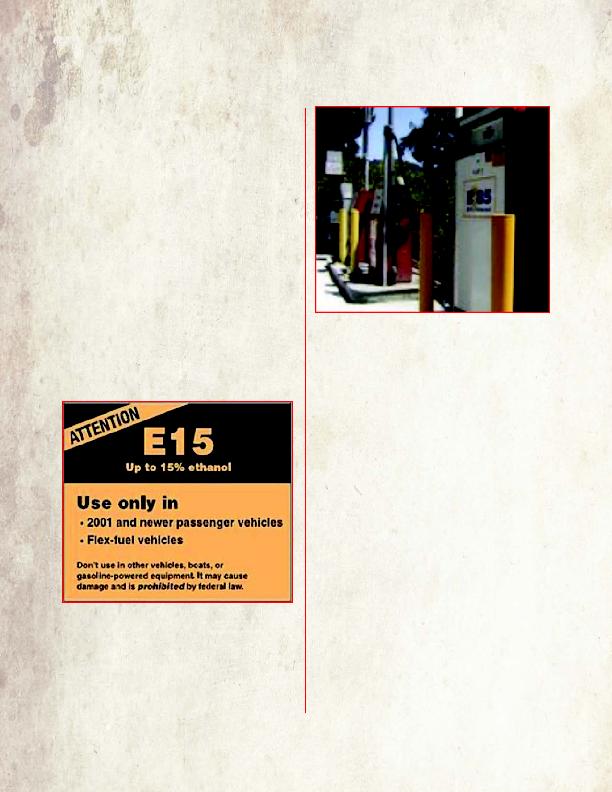
to area. Ethanol blended fuels are sold under
a designation of the content of ethanol; this
is not to be confused with the normal octane
rating. Most consumer gasoline is sold as an
E10 blend (90% gasoline and 10% ethanol),
but the allowance to upgrade to E15 has
been approved.
In many areas it is common to find gas station
that sell an E85 blend, for flex fuel vehicles.
As vehicle operators we must understand
what blend of fuel that our vehicles can
accept.
Beyond the consumer standpoint, let's look
at what ethanol blended fuels mean to us.
Ethanol is grain alcohol, the same as what
Granny used on the "Beverly Hillbillies"
to treat her rheumatism. To keep ethanol
for fuel from being a consumable product,
small amounts of gasoline are added to the
product to make it undrinkable. Ethanol
does however, force us to alter some basic
things we have been taught. From our first
HAZMAT lesson in elementary school,
we learned that oil and water do not mix,
with oils floating on top of the water. This
makes confinement of fuel spills into water,
easier to accomplish. However, later in
life we probably learned how well alcohol
blended with water, in a consumable form.
Ethanol lacks moisture when it is used a fuel
additive, for obvious reasons. The problem
come from the fact that ethanol loves water.
It does a very good job of drawing moisture
from surrounding sources. So a fuel spill
into water, will now lose it's ethanol content
into the water, causing the spill not to be
as easily contained with boom, underflow
30 Backdraft Magazine | A Volunteer Fire Service Publication | Volume 5 | Issue 1 | www.thebackdraftmagazine.com